
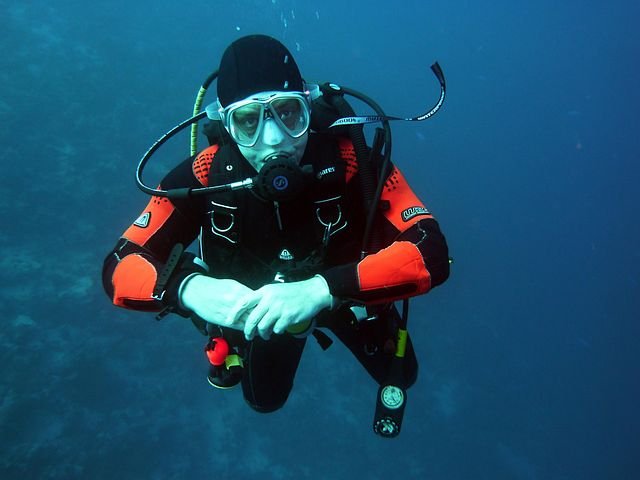
Discover the secrets to effortless dives, better air consumption, and reef-safe diving.
Congratulations on your diver certification! You should think of it as a license to learn, as your diving career has only begun.
Imagine descending into crystal-clear waters only to crash into a reef or kick up a cloud of silt. Your dive buddy signals “calm down,” but your trim is off, your breathing is erratic, and you’re bobbing like a cork. Every diver starts here. Somewhere, you remember someone saying, “Slow is smooth and smooth is fast.“
In this case, it is more about effectiveness and efficiency, not speed. But mastering buoyancy control isn’t just about looking cool underwater; it’s essential for safety, comfort, marine and energy conservation, and maximizing your dive enjoyment.
In this ultimate guide, you’ll learn:
- The simple physics of buoyancy
- The best gear for buoyancy control
- Drills and tips to master buoyancy
- Common mistakes and how to fix them
- How to keep improving beyond your Open Water cert
The Physics of Buoyancy (Simplified)
Neutral buoyancy is the sweet spot where you neither sink nor float. It allows divers to hover effortlessly in mid-water and glide through the ocean with minimal effort.
Let’s keep it simple:
- Positive buoyancy: You float
- Negative buoyancy: You sink
- Neutral buoyancy: You hover
This balance is achieved by adjusting your weight, fine-tuning your breath, and using your BCD (Buoyancy Control Device) properly. Archimedes’ Principle tells us that an object submerged in a fluid is buoyed up by a force equal to the weight of the fluid displaced. In diving terms, if you’re too heavy, you’ll sink; if you’re too light, you’ll float.
The main factors influencing buoyancy are:
- Your total weight and distribution
- The amount of air in your Buoyancy Compensator Device (BCD)
- The amount of air in your lungs, yes, your lungs work like a mini-BCD!
Gear Considerations for Buoyancy
BCD
Your BCD is your main buoyancy tool. Jacket-style BCDs are common among beginners, while wing-style options offer better trim and are favored by experienced divers.
- Ensure a proper fit: Too loose and it shifts around; too tight and you’ll feel restricted.
- Lift capacity matters: Make sure your BCD can compensate for your weight and equipment.
Weights
Proper weighting is everything.
Several variables can affect the amount of weight needed, including wetsuit thickness, tank type (aluminum or steel), water type (freshwater vs. saltwater), and water temperature, all of which have a direct influence on the required amount of weight.
-
- Too much weight = excess air needed in BCD, poor trim
- Too little weight = uncontrolled ascent
- Weight distribution. Distribute weight evenly from side to side.
Do a pre-dive weight check.
Find a shallow pool edge or dock where you can safely place your weights for easy access, perhaps near a ladder.
-
- Enter the water with all your gear and the estimated weights.
- At the surface, with a full tank, float at eye level with a normal breath.
- Deflate your BCD completely (you should still be floating at eye level)
- Exhale, and you should slowly sink.
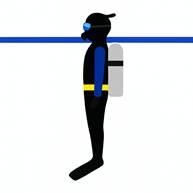
Troubleshooting:
-
- If you don’t sink or float too high, you are underweighted, so add weight and repeat the check until the water reaches eye level.
- If you sink immediately, you’re likely overweighted, so remove weight until you float at eye level.
Pro Tip – When making adjustments to your weight, do so with small increments of 1 to 2 lbs. at a time.
Pro Tip – Log your findings in your logbook. Buoyancy characteristics will change over time, but it is good to document as you go. Use it as a reference later. Fully identify all of your equipment.
Regulator / Alternate Air Source
Your breathing directly affects buoyancy. Slow, deep breaths will make you rise; slow, shallow ones will make you sink.
*The Dive Rite XT4 pictured below is actually a right-hand regulator. I have contacted the seller and asked that they correct the error.
Wetsuit
Thicker wetsuits are more buoyant and compress with depth. Beginners do not typically use drysuits and require additional training.
Fins
Efficient fins and finning techniques help maintain balance without disturbing the environment.
Mastering Buoyancy: Step-by-Step Drills & Techniques
1. Pre-Dive Weight Check
-
- See above
2. BCD Inflation/Deflation
-
- Add or release air in short bursts
- Always pause to check the result
- Never continuously inflate or deflate
3. Breath Control
-
- Inhale = ascend
- Exhale = descend
Practice controlling depth with your lungs only. Remember to never hold your breath while ascending or descending.
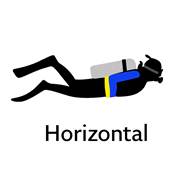
4. Trim & Body Position
-
- Aim for a horizontal position
- Tuck your chin slightly, arms forward
- Keep knees bent slightly with fins elevated
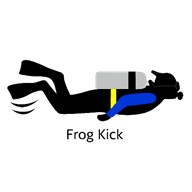
5. Finning Techniques
-
- Avoid sculling or using your hands. Remember, you are diving, not swimming
- Frog kick is ideal for control and minimal disruption
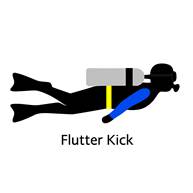
- Flutter kick from the hip, not the knees. Offers more propulsion but more environmental disruption
6. Hovering Drills
-
- In a pool or calm water, cross your legs, fold your arms, and hover
- Practice maintaining neutral buoyancy for 30 seconds, then for a minute
7. Post-Dive Weight Check
Conduct another check during your safety stop at 5 meters with a near-empty tank (around 50 bar/500 psi). With an empty BCD and, if weighted correctly, you should be relatively stable with an empty BCD.
Common Buoyancy Mistakes & How to Fix Them
- Over-weighting: Causes overuse of BCD and awkward posture
- Over/Under-inflating BCD: Small bursts, not large dumps
- Ignoring breath control: Leads to rollercoaster dives
- Poor trim: Upright posture adds drag, instability, and possible seafloor disruption
- Panicked ascents/descents: Relax, breathe slowly, and control with breath and small BCD adjustments. In most instances, it is better to make adjustments at depth than to bounce (return to the surface and again at depth)
Beyond the Basics: Continuous Improvement
- Consider the Peak Performance Buoyancy specialty course with your certifying agency.
- Dive with experienced buddies and observe their techniques
- Log each dive: record what worked and what didn’t
- Reflect and practice consistently
- Every dive is a learning opportunity. Take advantage of it.
Conclusion
Mastering buoyancy control is the turning point from being an “okay diver” to becoming a confident, eco-friendly, and skilled one. Better buoyancy means:
- Longer bottom time
- Lower air consumption
- Safer, more enjoyable dives
- A healthier marine environment
If you continue to have concerns with your buoyancy, do not get frustrated. You are not alone. Many of the certifying agencies have courses specifically designed to teach this often-underrated skill. Consider reaching out to your local dive shop, broden you dive buddy pool, or if you live in the boonies like I do, you can always contact one of the following:
 Which Should You Choose?
PADI (Professional Association of Diving Instructors)
-
- Course Name: Peak Performance Buoyancy Specialty
- Focus: Fine-tuning weight distribution, trim, breathing techniques, and controlled hovering.
- Widely available worldwide since PADI is the largest recreational agency.
NAUI (National Association of Underwater Instructors)
-
- Course Name: Mastering Buoyancy Workshop / Buoyancy Control (varies by instructor/shop).
- Focus: Streamlining gear, weight checks, and eco-friendly buoyancy (protecting reefs).
- NAUI tends to emphasize diver independence and awareness.
SSI (Scuba Schools International)
-
- Course Name: Perfect Buoyancy Specialty
- Focus: Breathing control, body position, precise movement.
- Often bundled early in training since SSI emphasizes buoyancy as a foundational skill.
SDI (Scuba Diving International)
-
- Course Name: Advanced Buoyancy Control Specialty
- Focus: Buoyancy for safe ascents/descents, gear adjustments, and preparation for advanced courses like wreck or tech diving.
BSAC (British Sub-Aqua Club)
-
- While not a standalone course, buoyancy is built deeply into Ocean Diver and Sports Diver training.
- Some branches run dedicated workshops for buoyancy improvement.
Other Options
-
- GUE (Global Underwater Explorers) → Their Fundamentals Course is famous for rigorous buoyancy & trim mastery (often required for tech/cave diving).
- RAID (Rebreather Association of International Divers) → Includes buoyancy control in Core Specialties with a strong emphasis on minimal environmental impact.
As an Amazon Associate, Scuba Insider may earn a small commission from qualifying purchases at no additional cost to the customer.
Share your biggest breakthrough in buoyancy in the comments below!
Suggest a Topic
What scuba topic should we dive into next?
Have an idea for gear, destinations, or conservation? Share your suggestion below—we may feature it in an upcoming post!
