
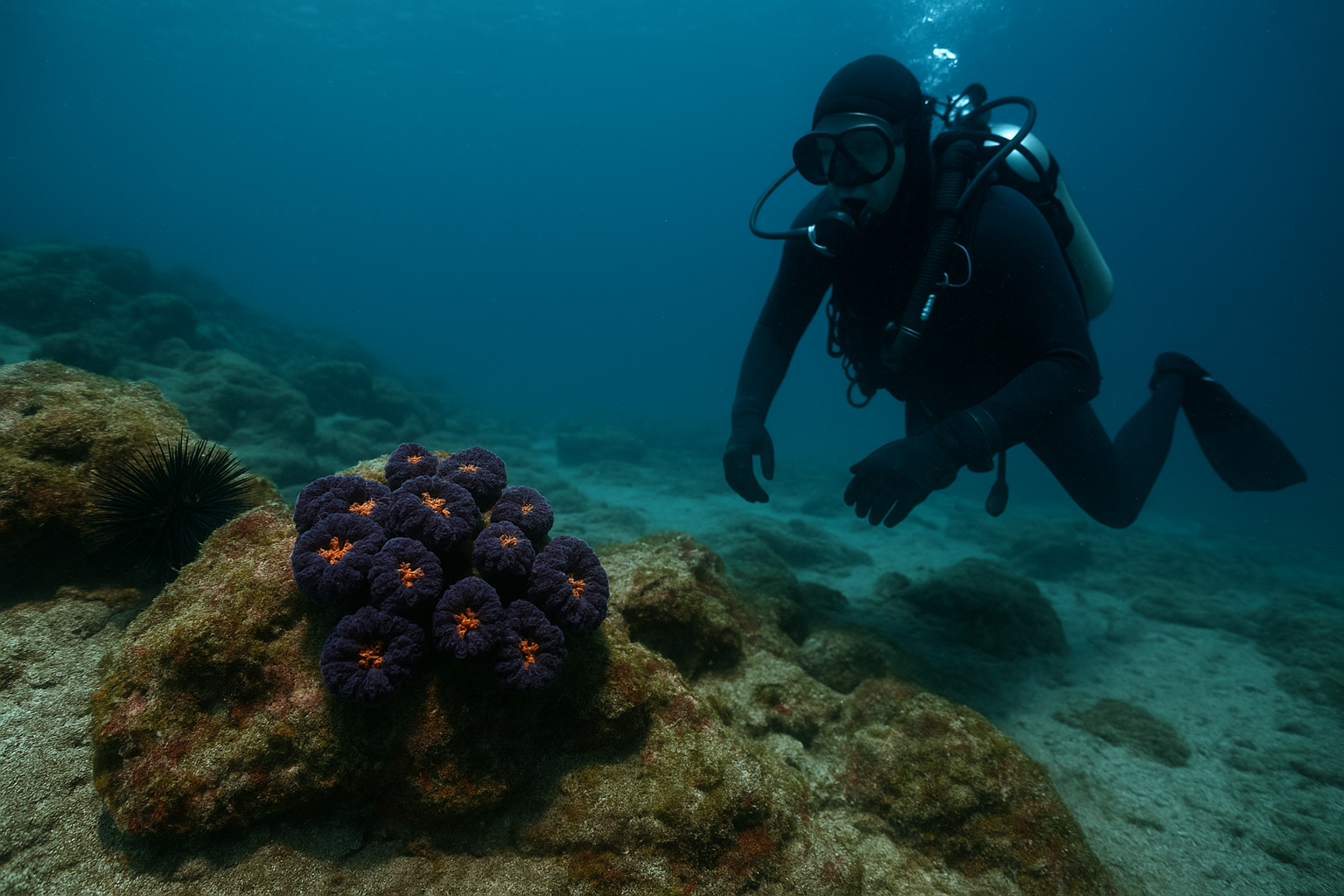
Keyword(s): Wellington’s Solitary Coral
🪸 A Lost Species Resurfaces Beneath the Waves
In early 2025, marine scientists made a discovery that sent waves of excitement across the global diving and conservation community. A coral species thought extinct for more than two decades—Wellington’s Solitary Coral (Rhizopsammia wellingtoni)—was found thriving in the depths of the Galápagos Islands. Last recorded in the year 2000, this unique coral had all but disappeared after the devastating El Niño events of the early 1980s.
Now, after 25 years of presumed extinction, its reappearance marks not only a biological triumph but a hopeful symbol of nature’s resilience. For divers, marine scientists, and conservationists, it’s a profound reminder that what seems lost beneath the surface may yet endure.
Why This Coral Matters
Unlike most shallow-water reef-building corals, Rhizopsammia wellingtoni does not rely on photosynthetic algae (zooxanthellae) to survive. This allows it to thrive in mesophotic zones, deeper reef environments with minimal sunlight. These depths, often beyond the reach of recreational divers, are becoming increasingly important as thermal refuges in a warming world.
According to the Charles Darwin Foundation, more than 250 living colonies were found during a 2024 expedition co-led by the California Academy of Sciences and the Galápagos National Park Directorate. These colonies were located across four dive sites: Tagus Cove, Punta Vicente Roca, Playa Tortuga Negra, and Cabo Douglas—some of which had never before been documented as coral habitats.
Even more surprising was the diversity within the colonies: scientists noted two distinct color morphs—black-purple and red-black—consistent with museum specimens collected in the 1970s. This suggests that not only has the species survived, it has maintained enough genetic diversity to potentially support long-term population resilience.
“Finding Wellington’s Solitary Coral alive is like discovering a page torn from a lost chapter of the ocean’s story,”
Climate Clues Hidden in the Deep
Scientists believe that cooler water temperatures during recent La Niña cycles (2020–2023) may have facilitated the coral’s resurgence in shallower waters. The coral’s ability to survive in mesophotic zones has positioned it as a climate-change sentinel, offering clues about how reef ecosystems might adapt—or fail to adapt—to global warming.
This discovery also raises important questions: How many other deep-dwelling or cryptic species might we have overlooked? What conservation strategies can we deploy to protect these vulnerable ecosystems?
These findings are now being integrated into Galápagos marine zoning plans, and early genetic sampling is underway to assess colony connectivity. There’s hope that the species may soon be re-evaluated by the IUCN, where it is currently listed as Critically Endangered (Possibly Extinct).
Do you think deep-reef ecosystems are getting the attention they deserve in marine protection efforts?
The Diving Community’s Role
For scuba divers, this discovery is both a scientific marvel and a call to action. It highlights the importance of deep reef exploration and the role divers can play in supporting marine science.
If you’re planning a dive trip to the Galápagos or other mesophotic-rich destinations, consider connecting with conservation-focused dive operators. Many now offer citizen science programs, allowing recreational divers to assist with underwater surveys, reef health monitoring, and species identification.
The rediscovery of Wellington’s Solitary Coral also underscores why divers should follow low-impact practices, such as avoiding contact with the reef, maintaining proper buoyancy, and adhering to marine park regulations. Small actions at 30 feet—or 130 feet—can ripple through entire ecosystems. Speaking of low-impact practices, implementing the strategies in our article on Master Buoyancy Control: The Ultimate Guide for Beginners is one of the most effective ways to further enhance your results.
Visual Evidence & Imagery
The rediscovery has been well-documented across multiple sources, including:
Oceanographic Magazine and the Charles Darwin Foundation, which published high-resolution photos of the coral’s unique coloration and size—typically less than 1 cm wide.
Scientific divers, including Dr. Albright, have been photographed conducting tissue sampling and reef mapping.
Side-by-side images show coral colonies next to reef features like sea urchins and volcanic substrate, offering helpful reference points for identification.
These images are not just scientific records—they are visual proof that conservation efforts and underwater exploration are still uncovering Earth’s marine mysteries.
Final Thoughts
The reemergence of Wellington’s Solitary Coral offers a rare and tangible reason for optimism. In an age when most ocean stories are defined by loss—bleaching, acidification, extinction—this rediscovery reminds us that with the right protections, some stories can still be rewritten.
For the global diving community, this is more than a headline—it’s a moment to celebrate, reflect, and recommit to protecting the reefs that continue to surprise and sustain us.


Leave a Comment