
The Ocean’s Role Beyond the Reef
Security & Stability
Earlier this week, I was reading an article on Indian Ocean conservation, and it sparked a realization. For over twenty years in the military, I routinely found myself in environments similar to those discussed here: fragile, semi-permissive, and at times, outright hostile. I’ve seen firsthand how delicate ecosystems and struggling communities can collapse under pressure.
In many of those regions, instability wasn’t driven by ideology or politics alone but often began when food sources grew scarce and the local environment could no longer sustain its people. Those experiences taught me a lasting truth: environmental security and human security are deeply interconnected.
Protecting our oceans, especially the vast and vital Indian Ocean, isn’t only about preserving marine life; it’s about ensuring stability, sustenance, and resilience for the millions who depend on it every single day.
When most people think about the ocean, they picture coral reefs, vibrant marine life, and the serenity of a dive. But beneath the surface beauty lies a deeper story, one that connects Indian Ocean conservation directly to global stability and human well-being.
The Indian Ocean is more than a dive destination or trade route; it’s a lifeline. It supports some of the most densely populated coastal regions on Earth, provides food and employment for millions, and serves as a critical artery for international commerce and energy flow. Yet, as pressures on this ecosystem grow from overfishing, pollution, and coral bleaching due to rising sea temperatures. The ocean’s capacity to sustain both life and livelihoods is being tested.
In fragile coastal communities, this environmental strain can quickly turn into human insecurity. When fishing stocks collapse or coral reefs die, entire local economies begin to unravel. Families lose income, young people migrate, and in some cases, bad actors exploit the resulting desperation to gain influence.
That’s why understanding the strategic and humanitarian importance of the Indian Ocean goes far beyond ecology. For those of us who’ve worked in complex environments, the link between a healthy ocean and a stable society isn’t abstract, but instead something we’ve seen play out in real time. Protecting the Indian Ocean’s ecosystems means protecting people’s futures, food security, and peace itself.
What’s the Big Issue?
The Indian Ocean’s Landscape: Environmental & Geopolitical
Stretching from the eastern coast of Africa to the shores of Southeast Asia and Australia, the Indian Ocean supports millions through fisheries, tourism, and trade routes. However, it faces escalating threats: climate change is driving rising sea temperatures and coral bleaching; overfishing and illegal, unreported, and unregulated (IUU) fishing deplete fish stocks and destabilize economies; and pollution, especially plastic waste, chokes marine habitats.
The environmental degradation also exacerbates security risks. Coastal communities dependent on the ocean for food and income face growing vulnerability. Competition over diminishing resources can spark conflicts, while rising sea levels threaten habitability, potentially displacing populations and increasing regional instability. On the maritime front, these challenges intersect with geopolitical rivalries, especially amid an expanding naval presence competing for influence over vital sea lanes.
Why It Matters for Divers
Marine & Community
For us scuba diving professionals, these issues hit close to home. Healthy reefs and abundant marine life are fundamental to dive experiences; degradation compromises both the environment and safety. Strong maritime security helps protect dive sites from illegal activities and unmanaged tourism that can damage fragile ecosystems.
Moreover, many dive destinations rely heavily on local economies linked to marine health. Supporting conservation efforts protects not only the ocean but the livelihoods of communities often welcoming divers as partners in stewardship. Awareness of these broader dynamics empowers divers to advocate responsibly and contribute meaningful support.
Underlying Regional Threats & Trends

National Identity & Geopolitics
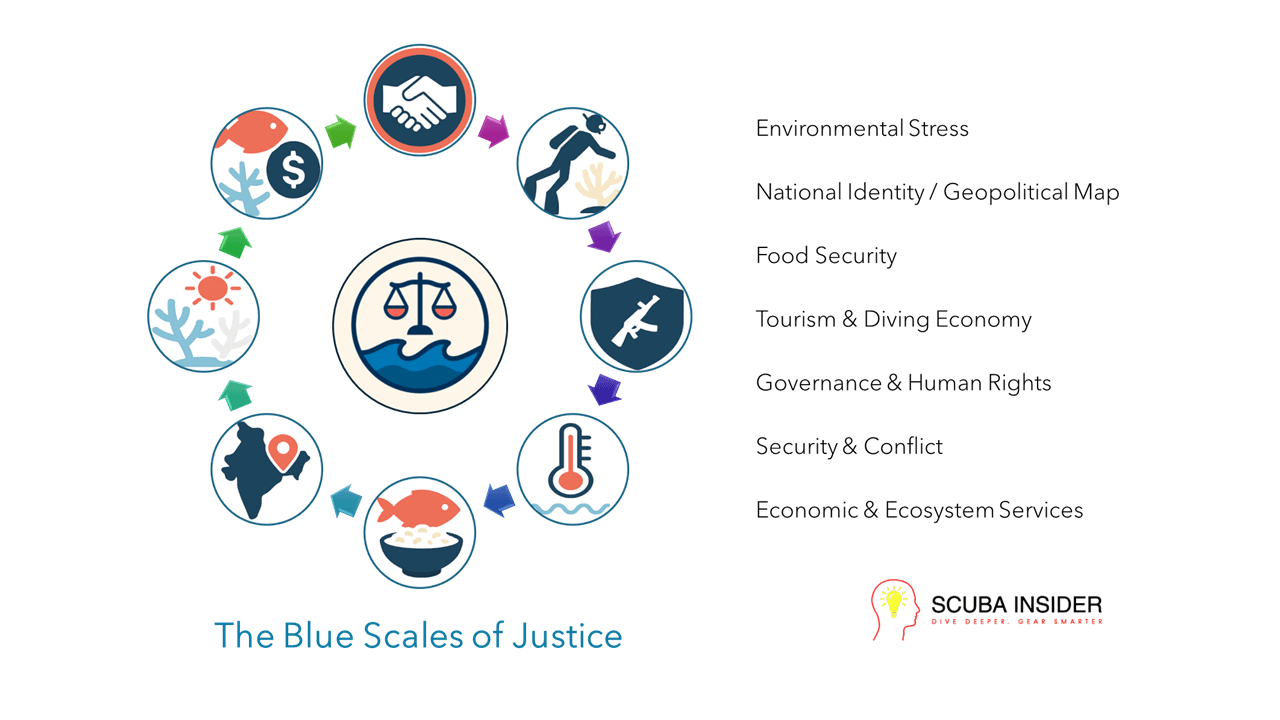
Each Indian Ocean nation faces unique challenges tied to its geography, governance, and dependence on marine resources. For island and coastal states, national security and economic stability are deeply intertwined with ocean health. When reefs collapse or fisheries decline, the ripple effects reach entire populations.
Food Security
The ocean remains a primary source of protein and livelihood for millions across the region. Overfishing, coral loss, and rising sea temperatures threaten these vital food chains, leaving communities increasingly vulnerable to scarcity and dependence on imported goods.


Environmental Stress
Climate-driven ocean warming is bleaching coral reefs and altering marine ecosystems faster than many nations can adapt. The loss of coral cover doesn’t just impact biodiversity; it erodes tourism, food production, and coastal protection, exposing both reefs and people to cascading risks.
Tourism & Dive Economy
Tourism and recreational diving are economic lifelines for many Indian Ocean states. When coral reefs degrade, visitor numbers fall, straining local economies that rely on dive operators, resorts, and marine parks. Sustainable tourism practices are essential to balance revenue with reef recovery.


Blue Economy & Ecosystem Services
Climate-driven ocean warming is bleaching coral reefs and altering marine ecosystems faster than many nations can adapt. The loss of coral cover doesn’t just impact biodiversity; it erodes tourism, food production, and coastal protection, exposing both reefs and people to cascading risks.
Governance & Cooperation
Shared waters require shared responsibility. Regional cooperation from anti-IUU enforcement to coral restoration and maritime safety is vital for stability. Transparent governance and cross-border coordination ensure that conservation and security goals advance together.


Security & Instability
As marine resources dwindle, economic desperation can fuel piracy, trafficking, and territorial disputes. Environmental decline becomes a security threat, transforming reefs and fisheries from sources of livelihood into flashpoints of conflict. Addressing root causes, not just symptoms, is key to long-term peace.
Coral Bleaching & Ocean Warming
Rising sea temperatures and prolonged heatwaves are bleaching reefs across the Indian Ocean — stripping coral of the symbiotic algae that give them color and life. Once-vibrant dive sites are turning ghostly white, affecting tourism, fish populations, and coastal resilience. Each degree of warming deepens the crisis, transforming coral bleaching from an isolated event into a regional emergency with ecological, economic, and cultural consequences.

Indian Ocean Conservation = Securing Our Future
Indian Ocean conservation is not just an environmental cause—it’s a regional security imperative with real implications for divers, coastal communities, and global stability. Understanding this interconnectedness empowers divers to become informed stewards who protect vulnerable marine ecosystems while supporting peaceful, sustainable relations in the region.
Stay connected with Scuba Insider for deeper dives into marine conservation, the latest policy updates, and practical tips for sustainable diving.
What Divers Can Do: Stewardship Beneath the Surface
Scuba divers can play a vital role in protecting the Indian Ocean’s future:
Practice responsible diving: Avoid contact with coral, follow local regulations, and support eco-friendly dive operators.
-
-
- Our article Master Buoyancy Control: The Ultimate Guide for Beginners can help with “no touch” coral practices.
- Also, an article we wrote, Left at Sea: Stories of Divers Adrift & How Not to Become One, has a pretty good write up on how to select eco-friendly operators.
-
Advocate for conservation: Engage with community projects, support marine protected areas, and stay informed about policy developments.
-
-
- In an article we wrote in August, Pillar Coral Spawns on Bonaire: A Historic Conservation Win, two sections, “Community and Collaboration” and “Turning Awe Into Action,” discuss in detail how we, professional divers, can get involved and collaborate with community projects.
-
Reduce pollution: Minimize plastic use, participate in local clean-ups, and promote ocean-friendly lifestyles.
[amazon table=”1611″]As an Amazon Associate, Scuba Insider may earn a small commission from qualifying purchases at no additional cost to the customer.
Educate fellow divers: Share knowledge about the link between conservation and security, fostering a community committed to ocean health.
-
-
- Please let me know if you feel as though we can assist your efforts in sharing knowledge amongst our communities about marine ecology, conservation, sustainability, or restoration. You can leave a comment below or email me directly @ john.millenaar@scubainisder.pro.
-
By integrating conservation into our diving lifestyle, we divers become active protectors of the ecosystems sustaining our adventures.
References
Transparency matters. Behind the toggle, you’ll find direct links to the reports, research papers, and expert sources that shaped this story. We encourage readers and divers alike to explore these materials and see how evidence and expertise guide every article we publish.
Lowy Institute. (2025, September 21). India’s ocean: A new report charts Delhi’s maritime direction. The Interpreter. https://www.lowyinstitute.org/the-interpreter/india-s-ocean-new-report-charts-delhi-s-maritime-direction
Maritime Executive. (2025, June 16). Diversifying threats to maritime security in the Western Indian Ocean. https://maritime-executive.com/editorials/diversifying-threats-to-maritime-security-in-the-western-indian-ocean
Brewster, D. (2023, June). Building a regional response against environmental security threats in the Indian Ocean. Indo-Pacific Environmental Security Partnership. https://ipesp.org/wp-content/uploads/2023/06/D3N_03_Brewster.pdf
Voyer, M., Quirk, G., McIlgorm, A., & Azmi, K. (2018). Blue growth and blue justice: Ten risks and solutions for the ocean economy. Marine Policy, 87, 340–348. https://doi.org/10.1016/j.marpol.2017.11.033


Leave a Comment